 English
 Español


In-House or Outsourced? How to Choose a Print-on-Demand Fulfillment Method
In-House or Outsourced? How to Choose a Print-on-Demand Fulfillment Method
Print on Demand
Print on demand allows a seller to offer decorated products without producing a large quantity before customers order. Once a sale occurs, the item is printed, packed, and shipped. The central decision is who will perform that work. You can fulfill orders with your own equipment, use an external production provider, or combine both methods. Each option can work, but the best choice depends on control, time, volume, product range, and customer expectations.
Understand the three fulfillment models
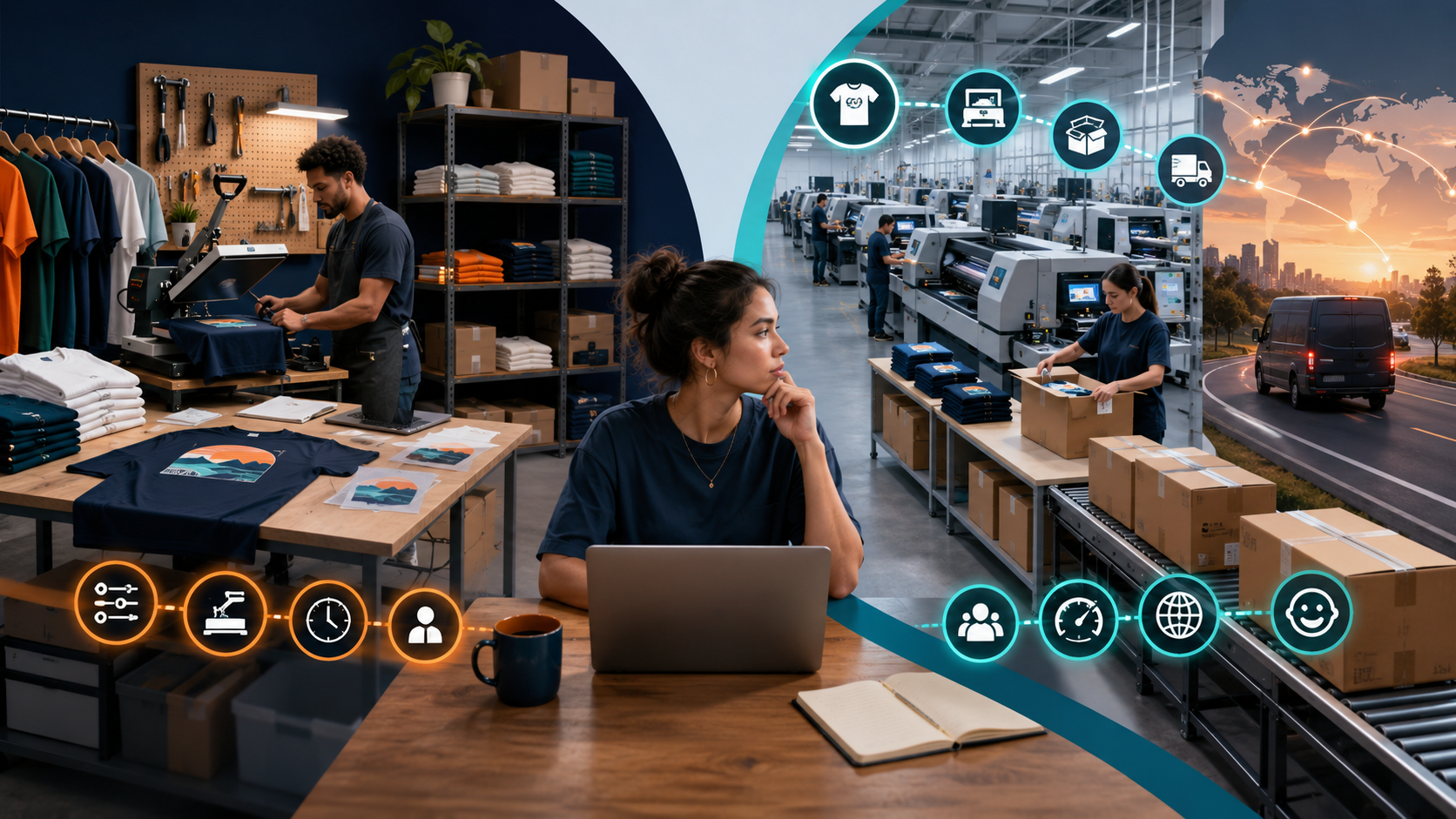
With in-house fulfillment, you purchase blank products, decorate them, inspect them, pack them, and arrange shipment. This gives you direct control over quality and presentation, but it also creates daily production responsibilities.
With outsourced fulfillment, a connected provider receives the order, produces the product, and ships it to the customer. You avoid operating the equipment and holding most inventory, but you depend on the provider's production standards, availability, packaging, and delivery performance.
A hybrid model uses both. You might produce local, urgent, customized, or higher-margin orders yourself while sending standard products or distant orders to a fulfillment partner. This flexibility can be useful, although it requires organized routing and consistent customer communication.
Compare the true startup commitment
In-house production may require a heat press or other decorating equipment, worktables, storage, blank garments, transfer supplies, packaging, safety procedures, and time to practice. The expense is not only the machine. Include maintenance, failed prints, utilities, workspace, software, supplies, and your production labor.
Outsourcing usually reduces the equipment commitment. Instead, evaluate product cost, printing charges, platform fees, shipping, taxes where applicable, samples, replacements, and the margin left after the sale. Low startup cost does not automatically mean high profit, so calculate the complete cost of each product before setting its price.
Decide how much control you need
Producing an item yourself lets you inspect every print, adjust placement, create custom packaging, include inserts, and respond quickly to unusual requests. This can support a premium or highly personalized brand. However, the customer experience depends on your ability to produce consistently during busy periods.
An external provider can deliver repeatable production at scale, but you may have limited control over packaging and minor production variations. Order samples before selling. Examine the blank product, print sharpness, color, placement, durability, packaging, and delivery experience as if you were the customer.
Evaluate time and capacity honestly
In-house fulfillment adds tasks to every order: retrieving the blank, preparing the design, pressing or printing, checking quality, folding, packing, purchasing postage, and handling pickup or drop-off. Estimate the minutes required and assign a value to your labor. If orders grow, determine how many items you can complete without delaying other business responsibilities.
Outsourcing frees production time for design, marketing, customer service, and product development. It does not eliminate work completely. You must still monitor orders, update customers, resolve address problems, handle defects, and maintain accurate listings.
Study product range and availability
Fulfillment partners may offer garments, mugs, posters, accessories, and products that would require several different machines to make yourself. A broad catalog can help you test ideas. At the same time, specific sizes, colors, or brands may become unavailable. Have a process for substitutions, disabled variants, and customer notifications.
In-house production gives you freedom to source blanks from different suppliers, but it may require storing popular variants. Too much inventory ties up cash and space. Start with a focused selection and expand after actual sales show what customers want.
Plan shipping and customer communication
Published production estimates and shipping windows should be realistic. Explain that production time and transit time are separate. If multiple providers fulfill one order, the customer may receive more than one package. Make this clear before checkout when possible.
Define who handles damaged items, incorrect sizes, lost packages, returns, and reprints. Review the provider's current policies, but create your own customer-facing policy based on what your business can reliably deliver.
Use a simple decision checklist
- Calculate full product, production, labor, fee, and shipping costs.
- Order and inspect samples from every fulfillment path.
- Estimate realistic daily and weekly production capacity.
- Decide how much customization and packaging control the brand needs.
- Confirm product availability and backup options.
- Document order routing, quality checks, delays, returns, and replacements.
- Test the entire purchase experience before promoting it widely.
Choose the model you can operate consistently
The right fulfillment method is not necessarily the largest or cheapest. It is the method that lets you protect quality, communicate accurately, maintain a healthy margin, and serve customers without overwhelming your operation. Begin with a manageable workflow, measure the real results, and add a second fulfillment path when it solves a demonstrated need.