 English
 Español


Print on Demand Explained: A Practical Way to Turn Your Design Into a Product
Print on Demand Explained: A Practical Way to Turn Your Design Into a Product
You may have seen custom T-shirts, hoodies, sweatshirts, tote bags, mugs, and other decorated products sold online without realizing how they were produced. Many of them begin with print on demand, commonly abbreviated as POD: a production model in which an item is printed after an order is placed or in the small quantity a customer actually needs.
For creators, organizations, small businesses, and individuals, POD can provide a more accessible path from an idea to a physical product. Instead of ordering a large inventory before knowing whether it will sell, you can begin with a design, select an appropriate product, and produce it according to demand.
How print on demand works
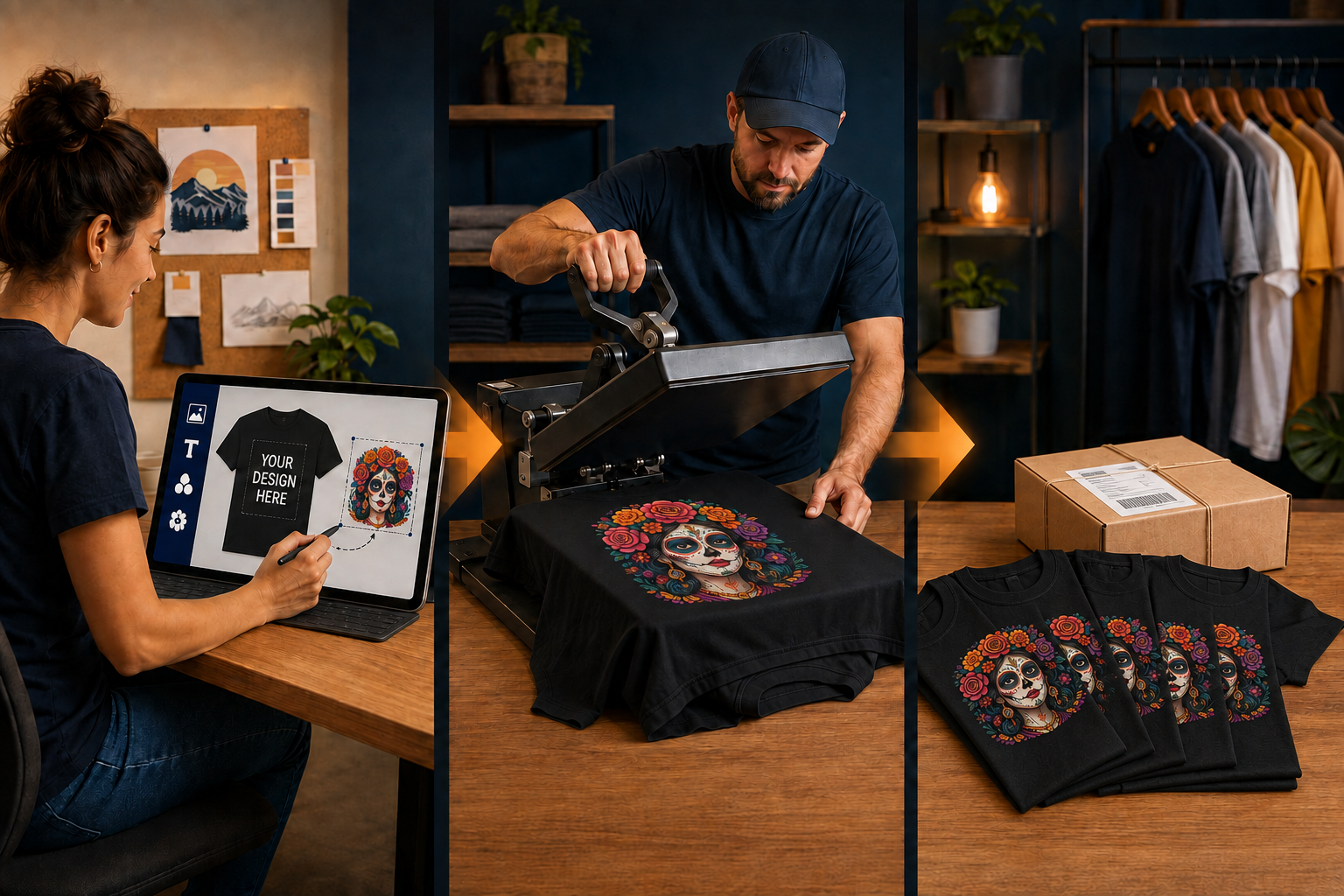
Although the exact workflow depends on the provider and printing method, a typical POD project follows several steps:
Develop the idea. The customer begins with artwork, a phrase, a logo, a photograph, or a creative concept.
Prepare the design. The artwork is adjusted to the required dimensions, resolution, color mode, and background.
Select a product. The customer chooses the garment or item, including color, size, material, and quantity.
Review the placement. A digital mockup or production preview shows approximately where the design will appear.
Produce the order. The product is decorated using the selected process.
Complete fulfillment. The finished item is inspected, packaged, and delivered or shipped according to the service arrangement.
Some services connect directly to an online store and automatically send customer orders to a fulfillment company. Other projects are handled more personally through an in-house press, which can provide hands-on communication and greater control over certain local or custom orders. A flexible POD service may use either approach depending on product availability, quantity, deadline, design, and destination.
POD is not only for established clothing brands
Print on demand can serve many purposes beyond launching a large apparel company. It may be appropriate for:
-
A small business that wants employee shirts
-
A family preparing garments for a reunion or celebration
-
A creator testing an original design
-
A school, club, team, church, or community organization
-
A podcast, channel, performer, or online personality developing merchandise
-
A business offering branded gifts to customers
-
A fundraiser or limited event
-
An individual ordering a personalized present
The common advantage is flexibility. The customer can focus on the purpose of the product rather than committing immediately to traditional bulk manufacturing.
What POD can help reduce
Traditional inventory requires money, storage, forecasting, and risk. A seller must decide how many units to purchase, which sizes will sell, and how long the products may remain unsold. POD can reduce some of that pressure by producing items closer to the moment of demand.
This can help reduce:
-
Large upfront inventory purchases
-
Storage requirements
-
Unsold seasonal merchandise
-
Guesswork about sizes and colors
-
The financial risk of testing a new concept
However, lower inventory risk does not mean every POD product is automatically profitable. Unit costs can be higher than large-volume production, and shipping, marketplace fees, payment-processing charges, returns, design work, taxes, and advertising still affect the final price.
In-house production and fulfillment partners
Different orders benefit from different production paths. An in-house press can be a strong choice for jobs that benefit from direct communication, local service, special attention, or practical control over the decoration process. It may also be helpful when a customer wants to discuss garment choices or review a project closely before production.
A fulfillment network such as Printify can provide access to a wider catalog and production partners in different locations. This can be useful for online orders, broader product selection, and shipping to customers outside the immediate area. Availability, production time, print method, and final quality can vary by provider and product, so each order should be evaluated individually.
The best solution is not always one system or the other. It is the production route that fits the customer’s design, quantity, budget, deadline, and delivery requirements.
A good design still needs production preparation
An image that looks attractive on a telephone screen is not automatically ready for garment printing. Production files may require sufficient resolution, appropriate dimensions, clean edges, correct transparency, readable lettering, and colors that work with the chosen garment.
Before approving an order, consider:
-
Is the artwork original or properly licensed?
-
Is the resolution suitable for the desired print size?
-
Does the design need a transparent background?
-
Will the colors remain visible on the garment color?
-
Is the smallest text large enough to print clearly?
-
Is the placement appropriate for the garment and available sizes?
-
Has the customer reviewed spelling, names, dates, and numbers?
A careful preview reduces surprises, but a digital mockup is still an approximation. Fabric, printing method, lighting, and screen calibration can affect how the physical result appears.
Pricing the complete project
The blank product is only one part of the cost. A complete quote may also reflect artwork preparation, printing, special placements, multiple colors or locations, packaging, taxes, shipping, and the quantity ordered. Customers should compare the entire delivered project—not only the advertised price of a blank shirt.
Businesses planning to resell POD products should calculate a realistic margin after all expenses. Good records are essential. Track product costs, fulfillment, shipping, refunds, platform fees, payment processing, advertising, and sales tax obligations. Revenue alone does not reveal whether a product is profitable.
Ready to create something tangible?
Print on demand makes it possible to begin with a single idea and turn it into something people can wear, use, share, or sell. Whether the right solution involves a local in-house press or an external fulfillment partner, the process should begin with the customer’s actual goal.
Explore POD services, describe your project, and request guidance on the product, artwork, production route, and quantity that fit your needs. You do not need to arrive with every technical answer. A good production conversation can help transform the concept into a practical order.